
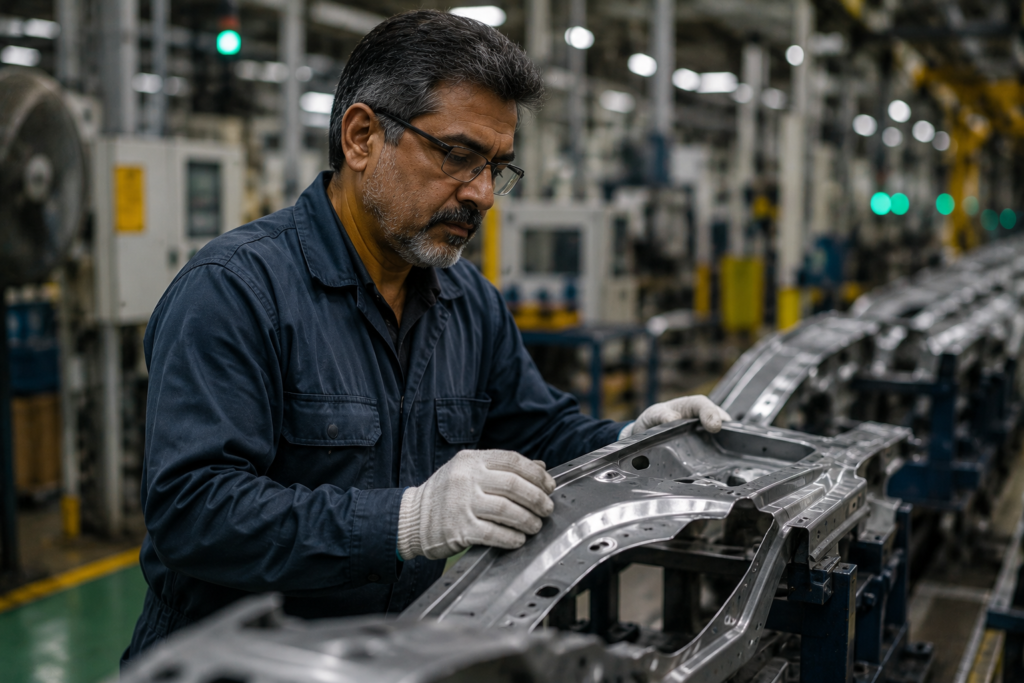
Here’s a sentence that shouldn’t make sense but does. In the same stretch of 2026 that saw AI blamed for the single highest month of job cuts ever recorded in the US, Ford quietly paid to bring back around 350 of the exact kind of veteran employees it had spent years trying to automate away. Both things happened. Neither cancels the other out. And together, they tell you more about where manufacturing jobs are actually headed than either story does on its own.
Ford Layoffs 2026, the Short Answer
Ford has cut roughly 11,000 jobs in 2025 alone, on top of thousands more since 2022, as part of a multi-year restructuring driven by a slower-than-expected shift to electric vehicles. Analysts project another 8,000 to 11,000 positions could be affected in 2026 as Ford retools its plants for more flexible production. At the same time, in June 2026, Ford rehired roughly 350 experienced engineers after its AI-driven quality inspection systems failed to catch defects at an acceptable rate, a genuinely unusual reversal in the middle of an otherwise steady downsizing trend.
The Numbers Behind Ford’s Layoffs Timeline
Ford’s job cuts didn’t happen in one dramatic announcement, they’ve built up steadily over four years. Here’s the timeline as it’s actually played out.
| Date | Workers affected | Reason |
| August 2022 | 3,000 | Model e EV division restructuring, shifting investment from gas to electric |
| July 2023 | 3,000 | Additional EV transition cost cuts and commercial vehicle division reductions |
| October 2024 | 800 | Product development and engineering team reductions |
| September 2025 | 1,000 | Cologne, Germany EV plant, slower than expected European EV demand |
| Throughout 2025 | 11,000 | Broader workforce reset as EV demand cooled and costs stayed high |
| 2026 (projected) | 8,000-11,000 | Analysts expect further cuts as Ford retools plants for flexible production |
Why Ford Layoffs Kept Happening, the EV Winter Explanation
The short version, Ford bet big on an aggressive electric vehicle transition through its Model e division, and the market didn’t move as fast as the bet assumed. High interest rates made big-ticket vehicle purchases harder to finance, charging infrastructure stayed patchier than promised, and consumer demand for EVs plateaued well below where automakers had planned their production capacity around. CEO Jim Farley has been unusually direct about the fallout, acknowledging publicly that Ford is simply too heavy, with cost structures built for a volume of EV sales that never fully materialized.
What started as a framed one-time reset in 2025 has stretched into a multi-year pattern instead. Ford ended up with what industry analysts call stranded capacity, plants and staffing levels built around EV volume projections that the actual market hasn’t caught up to yet.
The Twist, Ford Just Rehired Hundreds of Engineers It Had Automated Away
This is the part of the Ford layoffs story that most coverage misses entirely, because it broke just days before this article, in late June 2026. Ford’s chief operating officer Kumar Galhotra confirmed that the company had been leaning increasingly on automated, AI-driven quality inspection systems to catch manufacturing defects before vehicles reached customers. The results were disappointing enough that Ford brought back roughly 350 veteran engineers, some former employees, others pulled from suppliers, specifically to hunt for failure points on the plant floor before parts ever get installed.
Why the AI Quality Systems Fell Short
Automated inspection systems are genuinely good at catching the defects they’ve been trained to catch. What they’re worse at is the kind of pattern recognition that comes from years of hands-on experience with a specific production line, the subtle sound a press makes right before a die starts wearing unevenly, the visual tell that a supplier’s batch is running slightly off spec. Ford leaned on automation to replace exactly that kind of tacit expertise, and the defect rate showed the gap fairly quickly. It’s a real-world example of a broader pattern worth internalizing, treating an unverified assumption about a new technology as settled fact tends to get expensive well before anyone admits the assumption was wrong.
What This Means for the “AI Washing” Debate
May 2026 saw employers cite AI as the reason for 38,579 job cuts, the highest single-month total ever recorded for that stated cause, and critics have increasingly pushed back on companies using AI as convenient cover for cuts that are really about weak underlying performance. Ford’s rehiring doesn’t prove every AI-attributed layoff elsewhere was AI washing, but it’s a genuinely useful data point either way, a real company, in a real production environment, tested automation against experienced humans on a specific, measurable task, and reversed course when the results came back worse.
Ford’s Quality Turnaround, the Other Side of the Story
Here’s the detail that makes this story more than just a cautionary tale. Ford ranked first among mainstream brands in the latest JD Power Initial Quality Survey, a dramatic jump from tenth place the year before, and the company’s first time topping that ranking in 16 years. Executives have directly connected part of that improvement to bringing experienced engineers back onto the floor. Ford still carries a reputation as one of the most recalled automakers in the US, largely tied to issues from the prior automation-heavy period, but the trend line on quality is now moving in a direction worth watching.
What Ford Layoffs in 2026 Signal for the Broader Auto Industry
Ford isn’t alone in navigating this EV demand mismatch, and other automakers are watching its retooling process closely as a signal for their own planning. The bigger lesson for any company running through a similar transition is that genuine financial confidence means being willing to reverse a bet publicly and quickly once the data says it isn’t working, rather than doubling down on a strategy for the sake of consistency. Ford’s willingness to admit the AI quality experiment underperformed, and correct it within months rather than years, is a rarer trait among large manufacturers than it should be.
What This Means If You Work at Ford or a Ford Supplier
If you’re inside this industry watching the layoff numbers and wondering what it means for your own role, the honest read is mixed rather than uniformly bad. Roles tied directly to EV production volume that hasn’t materialized remain genuinely at risk through 2026. At the same time, Ford’s own rehiring wave shows that deep, hands-on manufacturing expertise, especially in quality control and failure analysis, is being actively re-valued rather than phased out. That’s a meaningfully different signal than a company simply shrinking across the board, and it’s worth factoring into any decision about where to specialize inside a manufacturing career right now.
Frequently Asked Questions
How many people has Ford laid off?
Ford cut approximately 11,000 positions throughout 2025 alone, part of a broader total exceeding 20,000 job cuts since 2022 tied to its EV transition. Analysts project an additional 8,000 to 11,000 layoffs could occur in 2026.
Why is Ford laying off workers in 2026?
Ford is laying off workers primarily because its electric vehicle sales growth has fallen short of the capacity and staffing levels the company built around its Model e division, leaving it with what analysts call stranded manufacturing capacity.
Did Ford rehire employees it laid off?
Yes. In June 2026, Ford rehired roughly 350 veteran engineers after its AI-driven quality inspection systems failed to catch manufacturing defects at an acceptable rate, bringing back hands-on expertise to identify failure points on the production line.
Is AI causing job losses at Ford?
AI played a role in some of Ford’s restructuring, but the primary driver of Ford’s layoffs has been slower-than-expected EV demand rather than automation itself. Notably, Ford’s AI quality systems underperformed badly enough that the company reversed course and rehired human engineers.
Will there be more Ford layoffs in 2026?
Analysts project Ford could cut an additional 8,000 to 11,000 jobs in 2026 as the company continues retooling its plants for more flexible production, though the exact scope depends on how EV demand and interest rates evolve through the year.