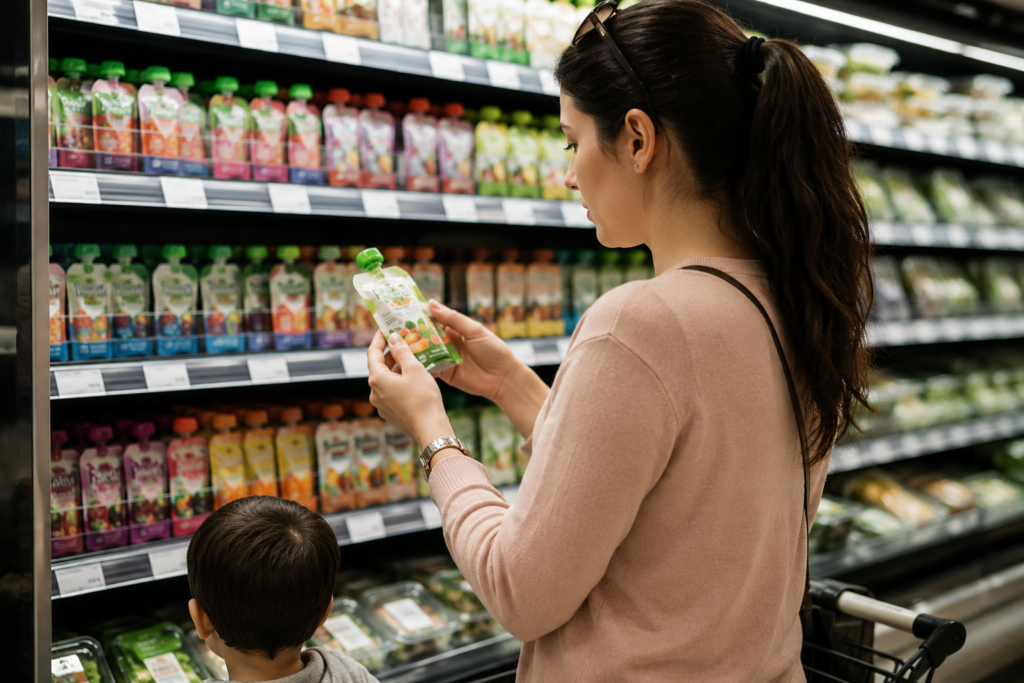
Most people know Once Upon a Farm from the cooler in the baby aisle, the little glass-front fridge stocked with cold-pressed pouches that costs noticeably more than the shelf-stable stuff next to it. What a lot of parents reaching for those pouches didn’t clock is that the company behind them just became a real test case for whether Wall Street still believes in premium food brands at all.
What Is Once Upon a Farm, and Why the IPO Was Such a Big Deal
Once Upon a Farm makes organic, cold-pressed baby food, toddler pouches, and kids’ snacks, built around a no-added-sugar, no-preservatives pitch aimed at parents willing to pay a premium for it. Cassandra Curtis and Ari Raz started the company in 2015 out of Curtis’s own kitchen in Berkeley, California, after she couldn’t find a store-bought baby food that met her own standards. In 2017, John Foraker, the former president of Annie’s at General Mills, and actress Jennifer Garner joined as co-founders, bringing both CPG industry credibility and genuine celebrity reach to a brand that was still, at that point, mostly known through farmers markets.
The Once Upon a Farm IPO mattered beyond one company’s balance sheet because it landed as a genuine litmus test. Consumer brand IPOs had been essentially frozen since 2022, with public investors far more excited about food-tech and AI than about premium grocery products. If Once Upon a Farm’s debut flopped, other venture-backed consumer brands sitting on shelved IPO plans would likely keep waiting. It didn’t flop.
Once Upon a Farm IPO, The Numbers That Matter
Here’s the full breakdown of how the debut actually played out.
| Detail | Figure |
| IPO date | February 6, 2026 |
| Stock ticker | NYSE: OFRM |
| IPO price | $18 per share, middle of the $17 to $19 range |
| Shares sold | About 11 million shares |
| Amount raised | $197.9 million |
| Valuation at IPO | $724 million |
| First-day close | Up 17 percent from the IPO price |
| Lead underwriters | Goldman Sachs and J.P. Morgan |
Shares opened at $21, up 16 percent from the offer price, and closed the first day up 17 percent. Within a few trading days, the stock climbed further, trading near $25 and putting it up close to 40 percent from where it priced. For a consumer brand IPO in a market that had gone cold on the category, that’s a genuinely strong open.
Why the Once Upon a Farm IPO Got Delayed
This wasn’t the company’s first attempt. Once Upon a Farm had originally planned to go public in 2025, before the longest government shutdown in US history disrupted the broader IPO market and pushed the timeline back. The company refiled and reset its sights on a February 2026 debut instead, ultimately landing in a week where seven separate companies raised over $150 million each in IPOs, a sign the broader IPO market was genuinely thawing alongside falling interest rates.
The Financials Behind the Once Upon a Farm IPO, Growth and Losses Side by Side
The prospectus told an honest, slightly two-sided story. In 2024, Once Upon a Farm posted net sales of $156.8 million, up 66 percent from the year before, genuinely fast growth for a food company at this scale. At the same time, its net losses widened from $17.6 million to $23.8 million over that same period. That combination, strong top-line growth paired with growing losses, is the exact pattern public investors have gotten far more skeptical of since 2022, which is part of why the company priced conservatively rather than chasing the aggressive multiples earlier premium CPG brands like Poppi and OLIPOP once commanded.
The Marketing Story Behind the Brand, Jennifer Garner and the “Farmer Jen” Persona
Garner’s role in this brand is a genuinely useful marketing case study on its own. She’s not a passive celebrity endorsement, she’s built a specific public identity around the company as “Farmer Jen,” paid $1 million in 2025 with $2 to 3 million in expected annual compensation through 2028, on top of stock options and an IPO-tied bonus, according to the company’s S-1 filing. That’s a founder-as-brand strategy executed with real financial commitment behind it, not a one-off ad campaign, and it’s a big part of why the company built consumer trust fast enough to reach 22,000 retail doors before ever touching a public market. It’s the kind of sustainable growth strategy that leans on genuine long-term brand equity rather than a short-term marketing spike.
Why Investors Bet on Once Upon a Farm Right Now
The Clean-Label and MAHA Tailwind
The IPO landed right as public sentiment turned harder against ultra-processed foods, particularly for children, a shift partly fueled by the Make America Healthy Again movement associated with Health and Human Services Secretary Robert F. Kennedy Jr. That cultural moment has genuinely hurt legacy Big Food brands while giving companies like Once Upon a Farm real tailwind, though it’s worth being honest that cultural moments like this one can shift again just as quickly as they arrived.
The Cooler Strategy as a Distribution Moat
One detail buried in the S-1 deserves more attention than it usually gets, Once Upon a Farm has deployed thousands of branded coolers directly into retail stores, replacing standard shelving in the baby aisle. That’s a genuinely clever distribution move, since it physically differentiates the brand from ambient-shelf competitors and gives the company more control over its retail presence than a typical CPG brand gets. It’s a real-world example of building financial confidence into a growth strategy through owned infrastructure rather than just ad spend.
What the Once Upon a Farm IPO Means for Other CPG Startups
A successful, well-priced debut like this one tends to unlock momentum for the rest of the category. Founders and operators sitting on shelved S-1 drafts now have real evidence that public investors will fund premium consumer brands again, provided the growth story comes with a credible path to narrowing losses rather than just chasing revenue at any cost. That’s a pattern worth internalizing well before any company gets near an actual filing, treating evidence-based decisions over pure assumption as a core discipline rather than something bolted on right before a roadshow.
Should You Actually Buy Once Upon a Farm Stock (OFRM)
This isn’t investment advice, and Once Upon a Farm’s own S-1 filing spells out real risk factors, including its ongoing net losses, reliance on a narrow product category, and exposure to shifting retail and regulatory trends. The company’s post-IPO price jump reflects genuine investor enthusiasm, but a strong first-week showing doesn’t guarantee long-term performance, plenty of IPOs that pop hard on day one cool off considerably once the initial excitement fades and quarterly earnings start rolling in. Anyone considering OFRM stock should read the full prospectus and weigh it against their own financial situation, ideally with input from a licensed financial advisor rather than a single article.
Frequently Asked Questions
When did Once Upon a Farm go public?
Once Upon a Farm went public on February 6, 2026, listing on the New York Stock Exchange under the ticker symbol OFRM after pricing its IPO at $18 per share the day before.
How much did Once Upon a Farm raise in its IPO?
Once Upon a Farm raised approximately $197.9 million in its IPO, selling about 11 million shares at $18 each, giving the company a valuation of roughly $724 million at the time of listing.
What is Once Upon a Farm’s stock ticker?
Once Upon a Farm trades on the New York Stock Exchange under the ticker symbol OFRM. Shares opened at $21 on their first trading day, up 16 percent from the IPO price.
Is Once Upon a Farm profitable?
No, Once Upon a Farm was not profitable at the time of its IPO. The company reported net sales of $156.8 million in 2024, up 66 percent year over year, but net losses widened to $23.8 million over the same period.
Who are Once Upon a Farm’s co-founders?
Once Upon a Farm was founded in 2015 by Cassandra Curtis and Ari Raz. John Foraker, former president of Annie’s, and actress Jennifer Garner joined as co-founders in 2017, with Foraker serving as CEO and Garner acting as the company’s public-facing spokesperson.