
The journey to becoming an elementary school teacher begins with a single, transformative decision: pursuing a bachelor’s degree in elementary education. This comprehensive program opens doors to one of the most rewarding and impactful careers available today. As classrooms evolve and education becomes increasingly vital to society’s future, the demand for qualified, passionate elementary education teachers continues to grow across the nation.
A bachelor’s degree in elementary education is more than just a credential—it’s a comprehensive preparation for shaping young minds during their most formative years. This specialized degree equips aspiring educators with essential pedagogical knowledge, classroom management techniques, child psychology understanding, and practical teaching experience. Whether you’re drawn to fostering early literacy, nurturing mathematical thinking, or inspiring scientific curiosity in children aged 5-11, this degree program provides the foundation you need.
In today’s competitive job market, elementary school teachers with proper certification and training are highly sought after. School districts nationwide face teacher shortages, particularly in elementary grades, making this an opportune time to enter the profession. Beyond job security, teaching offers intrinsic rewards that few other careers can match: the opportunity to make a lasting difference in children’s lives, contribute to community development, and experience the joy of watching students discover their potential.
This comprehensive guide explores everything you need to know about earning your bachelor’s degree in elementary education, from program requirements and coursework to career prospects and specialization options.
Understanding the Bachelor’s Degree in Elementary Education
What Is Elementary Education?
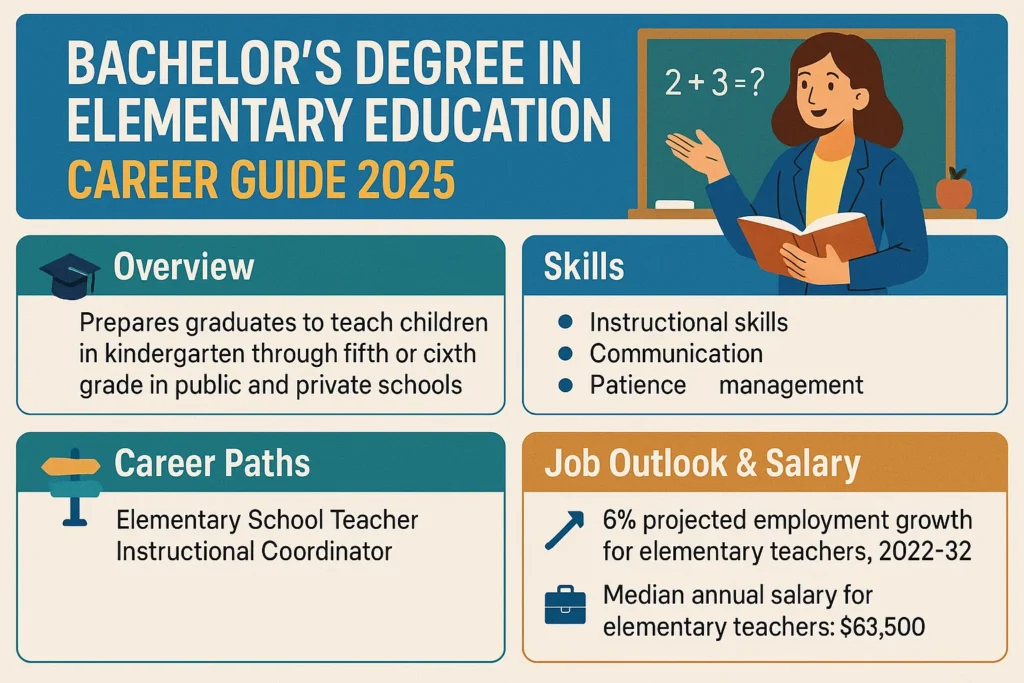
Elementary education refers to the foundational phase of formal schooling, typically encompassing kindergarten through fifth or sixth grade. This critical period focuses on developing fundamental academic skills, social-emotional competencies, and lifelong learning habits. A bachelor’s degree in elementary education specifically prepares graduates to teach multiple subjects across these grade levels, including reading, mathematics, science, social studies, and arts.
Core Program Components
Teacher preparation programs in elementary education combine theoretical knowledge with practical application. Students engage with educational psychology, learning theories, curriculum design, and assessment strategies. The curriculum typically includes coursework in child development, literacy instruction, mathematics education, classroom management, and inclusive teaching practices for diverse learners.
Most programs require 120-130 credit hours completed over four years, though accelerated and part-time options exist. Clinical experiences begin early, with observation hours in classrooms, followed by practicum placements, and culminating in a full-semester student teaching experience.
Essential Coursework and Curriculum
Foundational Education Courses
Education majors begin with foundational courses that introduce them to teaching philosophy, educational history, and contemporary issues in schooling. These classes explore questions about learning, equity, diversity, and the teacher’s role in society. Courses in educational psychology provide insights into how children think, learn, and develop cognitively and emotionally.
Subject-Specific Methods Courses
A distinguishing feature of elementary teacher education is the emphasis on teaching methods for multiple content areas. Students take specialized courses in literacy instruction, including phonics, reading comprehension strategies, and writing development. Mathematics methods courses cover number sense, problem-solving approaches, and making abstract concepts concrete for young learners.
Science and social studies methods courses prepare future teachers to design engaging, inquiry-based lessons. Arts integration courses demonstrate how music, visual arts, and movement enhance learning across all subjects.
Special Education and Differentiation
Modern teacher certification programs emphasize inclusive education. Coursework in special education introduces future teachers to learning disabilities, behavioral challenges, gifted education, and English language learners. Differentiation strategies enable teachers to meet diverse student needs within the same classroom, a critical skill in today’s heterogeneous schools.
Field Experience and Student Teaching
Observation and Early Field Experiences
Teacher preparation extends far beyond the college classroom. Early in their programs, students complete observation hours in various elementary settings. These experiences expose them to different teaching styles, grade levels, school cultures, and student populations. Structured observations help aspiring teachers connect theoretical concepts to real-world practice.
Practicum Placements
As students progress, practicum placements provide opportunities to work directly with children under mentor teacher supervision. During practicums, education students plan and deliver lessons, assess student understanding, and gradually assume more classroom responsibilities. These experiences build confidence and competence before the culminating student teaching semester.
Student Teaching Experience
The capstone of any bachelor’s degree in elementary education is student teaching—a full-semester immersion in classroom life. Student teachers assume full responsibility for planning, instruction, assessment, and classroom management while receiving guidance from cooperating teachers and university supervisors. This intensive experience provides invaluable preparation for the first year of independent teaching.
Certification and Licensure Requirements
State Certification Standards
Earning a bachelor’s degree in elementary education is typically the first step toward teacher certification, but states have varying licensure requirements. Most states require graduates to pass content knowledge exams, such as the Praxis series, demonstrating proficiency in subjects they’ll teach. Additionally, pedagogy assessments evaluate understanding of teaching principles and classroom management.
Background Checks and Additional Requirements
All teacher candidates must pass comprehensive background checks, including fingerprinting and criminal history reviews. Some states require tuberculosis testing, CPR certification, or additional coursework in topics like child abuse recognition or digital literacy before granting certification.
Alternative Certification Pathways
While traditional four-year programs remain the most common route, alternative certification pathways exist for career changers or those with bachelor’s degrees in other fields. These programs, often called post-baccalaureate certification or alternative licensure, compress pedagogical training into intensive formats while requiring supervised teaching experience.
Career Opportunities and Job Outlook
Elementary Teaching Positions
The most direct career path for elementary education graduates is classroom teaching in public or private schools. Elementary school teachers typically work with a single class of 20-30 students, teaching all core subjects. Self-contained classrooms allow teachers to build strong relationships with students and see their growth across multiple areas.
Specialized Teaching Roles
Beyond general classroom positions, opportunities exist in specialized areas. Reading specialists work with struggling readers, while gifted education teachers challenge advanced students. English as a Second Language (ESL) teachers support multilingual learners, and special education teachers serve students with disabilities.
Administrative and Support Roles
Experienced teachers often advance into leadership positions such as department chairs, curriculum coordinators, or instructional coaches. Some pursue administrative roles as assistant principals or principals after completing master’s degrees in educational leadership.
Job Market and Salary Expectations
The Bureau of Labor Statistics projects steady growth for elementary teaching positions through 2030. While salaries vary significantly by state and district, the median annual wage for elementary teachers exceeds $60,000, with experienced teachers in well-funded districts earning substantially more. Benefits typically include health insurance, retirement plans, and substantial vacation time.
Skills Developed Through the Program
Pedagogical Competencies
Elementary education degrees develop comprehensive teaching skills. Graduates master lesson planning, instructional delivery, formative and summative assessment, and data-driven instruction. They learn to create engaging learning environments that motivate students and foster curiosity.
Interpersonal and Communication Skills
Teaching requires exceptional communication abilities. Graduates develop skills in explaining complex concepts simply, active listening, providing constructive feedback, and communicating effectively with parents and colleagues. Conflict resolution and collaboration become second nature.
Adaptability and Problem-Solving
Classrooms are dynamic environments requiring quick thinking and flexibility. Teacher education programs cultivate adaptability, helping future educators respond to unexpected challenges, differentiate instruction spontaneously, and find creative solutions to learning obstacles.
Choosing the Right Program
Accreditation Matters
When selecting a teacher preparation program, accreditation is paramount. Programs accredited by the Council for Accreditation of Educator Preparation (CAEP) meet rigorous quality standards and ensure your degree will be recognized for certification purposes nationwide.
Program Format Options
Modern elementary education degrees come in various formats. Traditional on-campus programs offer face-to-face instruction and extensive networking opportunities. Online and hybrid programs provide flexibility for working adults or those with family commitments. Accelerated programs allow motivated students to complete degrees faster.
Location and Career Goals
Consider where you plan to teach when selecting a program. Attending college in your target state simplifies the certification process, as programs align with state standards. Additionally, student teaching placements often lead to job offers, making geographic considerations important.
Conclusion
A bachelor’s degree in elementary education represents an investment in both your future and society’s future. This comprehensive program prepares compassionate, skilled educators who will shape the next generation’s minds and hearts. From foundational coursework and methods classes to intensive field experiences and student teaching, every component builds toward successful classroom practice.
The path to becoming an elementary school teacher demands dedication, patience, and genuine love for children and learning. However, the rewards—both personal and professional—are immeasurable. As you guide students through critical developmental years, you’ll witness transformative moments daily: the struggling reader who finally decodes a word, the anxious student who gains confidence, the curious mind that asks profound questions.
If you’re passionate about education, children’s development, and making meaningful societal contributions, pursuing a bachelor’s degree in elementary education may be your calling. The teaching profession needs committed individuals ready to inspire, challenge, and nurture young learners. Begin your journey today and discover the profound satisfaction that comes from shaping future generations.
FAQs
1. How long does it take to complete a bachelor’s degree in elementary education?
Typically, a bachelor’s degree in elementary education requires four years of full-time study, encompassing 120-130 credit hours. However, accelerated programs may allow completion in three years, while part-time students might need five to six years. Online and hybrid formats offer flexibility for working professionals.
2. Can I teach with an elementary education degree in any state?
While earning your degree in one state doesn’t automatically grant teaching licensure everywhere, most states have reciprocity agreements recognizing out-of-state credentials. You’ll typically need to apply for certification in your desired state, which may require additional exams or coursework specific to that state’s requirements.
3. What is the difference between elementary education and early childhood education degrees?
Elementary education degrees prepare teachers for grades K-5 or K-6, focusing on children ages 5-11. Early childhood education programs target younger children, typically birth through age 8 or grade 3, with emphasis on developmental milestones and play-based learning. The grade ranges and pedagogical approaches differ significantly.
4. Do I need a master’s degree to teach elementary school?
No, a bachelor’s degree with proper state certification is sufficient to begin teaching elementary school. However, many districts offer salary increases for master’s degrees, and some states require teachers to earn advanced degrees within a specified timeframe after initial certification.
5. What is the average salary for elementary school teachers?
According to recent data, elementary school teachers earn a median annual salary around $61,000 nationally. However, compensation varies widely based on location, experience, and education level. Teachers in high-cost urban areas or well-funded suburban districts often earn $70,000-$90,000 or more, while rural areas may offer lower salaries.
Read More:Free Adult Education 7 Amazing Breakthroughs in 2025