The runways of Paris Men’s Fashion Week have long been a theater of innovation, but recent seasons have witnessed something far more profound than mere trend-setting. What we’re seeing isn’t just fashion evolution—it’s a full-scale revolution in how we define masculinity through clothing. Designers are asking a question that challenges centuries of sartorial convention: what can’t a man wear? And increasingly, the answer seems to be: absolutely nothing.
From flowing skirts to delicate lace, from transparent fabrics to traditionally feminine silhouettes, Paris Men’s Fashion Week has become ground zero for dismantling the rigid boundaries that have historically separated men’s and women’s wardrobes. Men’s Fashion Revolution : This isn’t about shock value or temporary spectacle. Instead, it represents a fundamental reimagining of masculine fashion that reflects broader cultural shifts in how society understands gender, identity, and self-expression.
The transformation happening on Parisian catwalks isn’t occurring in isolation. It mirrors conversations happening in boardrooms, universities, and living rooms worldwide about gender fluidity, personal freedom, and the arbitrary nature of fashion rules that have governed men’s clothing for generations. As younger consumers increasingly reject binary thinking about gender and style, designers are responding with collections that offer men the same creative freedom that women have long enjoyed in fashion.
This article explores how contemporary designers are breaking convention at Paris Men’s Fashion Week, the cultural forces driving this change, and what this means for the future of menswear. We’ll examine specific collections, designer philosophies, and the broader implications of this fashion revolution that’s rewriting the rulebook on masculine style.
The Historical Context: How Men’s Fashion Became So Restrictive
To understand the significance of what’s happening at Paris Men’s Fashion Week, we must first acknowledge how we arrived at such a restricted vision of men’s clothing. The history of masculine attire reveals that the narrow parameters we consider “normal” for men today are actually relatively recent constructions.
The Great Masculine Renunciation
Fashion historians point to what’s called the “Great Masculine Renunciation” of the late 18th and early 19th centuries, when men largely abandoned the colorful, ornate clothing they had worn for centuries. Before this period, wealthy European men regularly wore silk stockings, elaborate embroidery, vibrant colors, high heels, and even makeup. The shift toward sober, dark, minimalist clothing coincided with the Industrial Revolution and emerging middle-class values that associated flamboyance with frivolity and moral weakness.
This renunciation created what we now recognize as the modern men’s suit—a uniform of conformity that has dominated professional men’s fashion for over two centuries. While women’s fashion continued to evolve, experiment, and play with silhouettes, colors, and fabrics, men’s clothing became increasingly standardized and restricted.
Contemporary Catalysts for Change
Several factors have converged to create the current moment of fashion innovation at Paris Men’s Fashion Week. Social media has given visibility to alternative styles and non-binary fashion icons. The LGBTQ+ rights movement has created space for more expansive expressions of gender and identity. Younger generations, particularly Gen Z, increasingly view gender norms as outdated constructs rather than immutable truths.
Additionally, the streetwear revolution demonstrated that menswear could be creative, expressive, and commercially successful while breaking traditional rules. This paved the way for high fashion to push even further, exploring territories once considered taboo for masculine presentation.
Designers Leading the Revolution

Alessandro Michele’s Gucci: The Catalyst
When Alessandro Michele took the helm at Gucci in 2015, he didn’t just design clothes—he launched a manifesto. His collections featured men in pussy-bow blouses, floral embroidery, and silhouettes that blurred the line between masculine and feminine. Michele’s runway shows became celebrations of maximalism, androgyny, and historical reference that challenged every assumption about what men should wear.
Michele’s influence extended far beyond Gucci. He demonstrated that gender-neutral fashion could be both critically acclaimed and commercially successful, opening the door for other designers to experiment more boldly. His work proved that contemporary menswear could embrace beauty, decoration, and emotional expression without sacrificing sophistication or desirability.
Rick Owens: Subverting Silhouettes
Rick Owens has built an entire aesthetic empire on subversion. At Paris Men’s Fashion Week, Owens has repeatedly featured men in skirts, dresses, and flowing garments that completely reimagine the male form. His approach isn’t about feminizing men but rather about expanding the vocabulary of masculine presentation to include elongated silhouettes, dramatic proportions, and unconventional constructions.
Owens’ work questions why certain garments are gendered at all. His collections demonstrate that skirts can be powerful, architectural, and unmistakably masculine—not despite their form but because of how they’re constructed, styled, and presented.
Jonathan Anderson for Loewe: Artistic Experimentation
Jonathan Anderson’s work at Loewe represents perhaps the most intellectually rigorous approach to breaking fashion conventions. Anderson treats clothing as sculpture, creating pieces that challenge not just gender norms but the fundamental relationship between body and garment. His men’s collections have featured everything from knitwear that resembles paintings to silhouettes that seem to defy gravity.
Anderson’s philosophy centers on creative expression rather than shock. He’s interested in how clothing can communicate ideas, emotions, and identities that transcend binary categories. This approach has made Loewe’s menswear shows among the most anticipated and discussed at Paris Fashion Week.
Virgil Abloh’s Legacy at Louis Vuitton
Though Virgil Abloh’s tenure at Louis Vuitton Men’s was tragically cut short by his death in 2021, his impact on masculine fashion continues to resonate. Abloh brought streetwear sensibility to high fashion while consistently questioning the arbitrary rules that govern menswear. He styled men in skirts, used pastel colors traditionally coded as feminine, and celebrated diversity in body types and presentations.
Abloh’s work demonstrated that luxury menswear could be simultaneously accessible and avant-garde, rooted in street culture while pushing toward future possibilities. His shows at Paris Fashion Week were cultural events that transcended fashion, sparking conversations about identity, race, and the democratization of style.
What the Runways Are Showing Us: Men’s Fashion Revolution
Skirts and Dresses as Menswear Staples
Perhaps nothing symbolizes the fashion revolution more clearly than the proliferation of skirts and dresses on men’s runways in Paris. These aren’t tentative experiments—they’re full-throated declarations that garments have no inherent gender. Designers are showing kilts, sarongs, wrap skirts, pleated skirts, and even evening gowns as legitimate options for masculine wardrobes.
The styling of these pieces is crucial. Rather than presenting them as costumes or drag, designers integrate skirts into otherwise conventional menswear looks. A man might wear a tailored blazer, oxford shirt, and tie with a pleated skirt instead of trousers. This normalization suggests these items as practical additions to men’s wardrobes rather than mere fashion statements.
Transparent and Sheer Fabrics
The use of transparent and sheer materials in menswear collections represents another significant departure from convention. Historically, revealing or delicate fabrics have been reserved for women’s clothing, with men’s garments prioritizing opacity and structure. Contemporary designers are rejecting this dichotomy, creating men’s pieces from lace, mesh, and gossamer-thin materials that reveal the body underneath.
This trend connects to broader conversations about masculine vulnerability and emotional openness. Just as sheer fabrics literally make the body more visible, they metaphorically suggest a willingness to be seen, to be vulnerable, to reject the armor of traditional masculine presentation.
Color and Embellishment
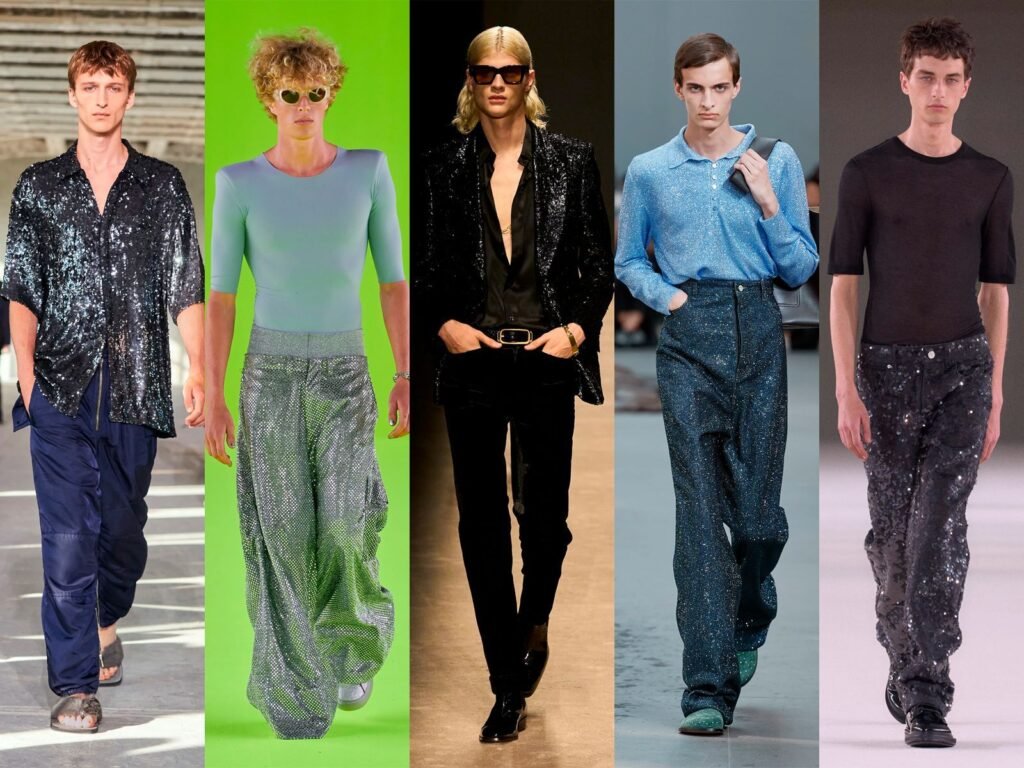
The color palette of contemporary menswear has exploded beyond the traditional navy, black, gray, and brown. Designers at Paris Fashion Week are showing men in hot pink, lavender, chartreuse, and every hue imaginable. Similarly, embellishment—from sequins to beading to elaborate embroidery—has become commonplace in men’s collections.
These choices reject the notion that decoration and color are frivolous or exclusively feminine. They assert that men, too, can embrace beauty for its own sake, that aesthetic pleasure is a universal human desire not bound by gender.
The Cultural Impact Beyond the Runway
Influencing Street Style and Everyday Fashion
While not every man will wear a skirt to work, the innovations appearing at Paris Fashion Week inevitably trickle down to influence everyday style. We’re seeing this in the growing acceptance of pink and pastel colors in mainstream menswear, the popularity of more fluid and relaxed silhouettes, and increased interest in accessories and styling for men.
Street style documentation from fashion weeks shows increasing numbers of attendees wearing gender-nonconforming looks. These aren’t exclusively models or industry insiders—they’re buyers, journalists, and fashion enthusiasts who see these shows and feel empowered to experiment with their own presentation.
Retail and Commercial Response
Major retailers have begun responding to the demand for more adventurous menswear. Brands like Zara, H&M, and ASOS now offer skirts and dresses in their men’s sections. While these pieces might be more conservative than what appears on Parisian runways, their mere presence in mainstream retail represents a significant shift.
Luxury brands report strong sales for their more experimental pieces, suggesting that the appetite for unconventional menswear extends beyond fashion insiders to actual consumers willing to invest in these garments. This commercial validation encourages designers to continue pushing boundaries.
Representation and Identity
Perhaps the most profound impact of this fashion revolution is in representation. When young people see diverse expressions of masculinity celebrated at the world’s most prestigious fashion event, it validates their own experiences and identities. For those who’ve never felt comfortable in traditional menswear, these collections offer a vision of possibility.
The visibility of gender-fluid fashion at events like Paris Men’s Fashion Week contributes to broader cultural conversations about identity, authenticity, and the right to self-determination in how we present ourselves to the world.
Challenges and Criticisms
The Question of Appropriation and Privilege
Not everyone celebrates the breaking of fashion conventions at Paris Men’s Fashion Week. Critics point out that marginalized communities—particularly LGBTQ+ individuals and people of color—have been wearing gender-nonconforming clothing for decades, often facing discrimination and violence as a result. Some argue that when wealthy, mostly white designers present these styles on runways, it represents appropriation of subcultural styles without acknowledgment or credit.
Additionally, the high price points of luxury fashion mean that these garments remain accessible primarily to wealthy consumers, raising questions about who truly benefits from this supposed democratization of style.
Commercial Viability and Tokenism
Skeptics question whether the most experimental runway pieces represent genuine change or merely tokenism—attention-grabbing spectacle that generates press coverage without reflecting actual shifts in what most men wear. Some industry observers note that while fashion shows might feature skirts prominently, the items that actually sell are often more conservative variations.
This raises important questions about the relationship between avant-garde fashion and commercial reality, and whether runway experimentation can drive meaningful cultural change if it doesn’t translate to actual wearing habits.
Cultural Context and Global Perspectives
The fashion revolution happening in Paris occurs within a specific Western cultural context. What reads as transgressive in Paris or New York might be traditional in other cultures where men regularly wear garments like kilts, sarongs, or robes. This highlights the culturally constructed nature of gender norms while also raising questions about whose conventions are being broken and for whose benefit.
The Future of Masculine Fashion

Predictions and Possibilities
The trajectory of menswear suggests we’re moving toward increasing fluidity and personalization. Rather than a single new standard replacing the old, we’re likely to see an expansion of acceptable options, with individuals choosing styles that align with their personal identity and aesthetic preferences.
Technology may play a role, with virtual try-on and AI styling tools making it easier for men to experiment with unconventional looks in low-risk environments. Social media will continue to provide visibility for diverse expressions of masculinity, normalizing what once seemed radical.
The Role of Paris Fashion Week
Paris Men’s Fashion Week will likely continue serving as a laboratory for experimentation, pushing boundaries that gradually become more mainstream. The city’s unique position in global fashion—combining historical prestige with contemporary relevance—makes it the ideal venue for these conversations and innovations.
As younger designers bring fresh perspectives to established houses and launch their own brands, we can expect continued questioning of what constitutes menswear and whose rules define it.
Conclusion
The transformation happening at Paris Men’s Fashion Week represents far more than a fleeting trend or seasonal novelty. It’s a fundamental reimagining of masculine identity through clothing—a rejection of arbitrary restrictions that have limited men’s self-expression for centuries. By asking “what can’t a man wear?” and answering “nothing,” designers are participating in a broader cultural conversation about gender, identity, and freedom.
This fashion revolution faces legitimate criticisms around appropriation, accessibility, and commercial viability. Yet its impact extends beyond the runway, influencing street style, retail offerings, and most importantly, how individuals understand their options for self-presentation. The work being done by contemporary designers validates diverse expressions of masculinity and creates space for experimentation.
As we look toward the future of menswear, the conventions being broken in Paris suggest we’re moving toward a more expansive, personalized approach to masculine style. The question is no longer what men can’t wear—it’s what they’ll choose to wear when all options are equally valid. That freedom, more than any specific garment or trend, may be the most lasting legacy of this moment in fashion history.
FAQs
Q: Are men really wearing skirts and dresses in everyday life, or is this just for fashion shows?
While the most experimental pieces remain primarily runway statements, there’s been measurable growth in men wearing gender-nonconforming clothing in everyday life, particularly among younger generations. Major retailers now stock skirts and dresses in their men’s sections, and street style photography shows increasing adoption of these garments. However, adoption varies significantly by geographic location, cultural context, and individual comfort level. The runway catalyzes broader acceptance, gradually normalizing what once seemed radical.
Q: Why is Paris specifically important for this fashion revolution?
Paris holds unique authority in global fashion due to its historical significance and concentration of prestigious fashion houses. What happens at Paris Fashion Week influences trends worldwide, giving innovations presented there particular cultural weight. The city’s combination of tradition and avant-garde experimentation makes it the ideal venue for challenging conventions while maintaining credibility. Additionally, Paris Fashion Week attracts international media coverage, ensuring that boundary-pushing designs reach global audiences.
Q: How do designers differentiate between men’s and women’s clothing if they’re using similar silhouettes and fabrics?
Many contemporary designers are intentionally blurring or eliminating these distinctions entirely, creating gender-neutral or gender-fluid collections. When distinctions exist, they often come down to sizing, fit proportions, and styling rather than fundamental differences in garments. Some designers maintain separate men’s and women’s lines primarily for retail and marketing purposes while drawing from similar aesthetic vocabularies. The trend is toward clothing designed for bodies and individuals rather than genders.
Q: Is this change driven by designers or by consumer demand?
It’s a reciprocal relationship. Younger consumers, particularly Gen Z, increasingly reject rigid gender norms and seek clothing that allows personal expression. Designers respond to and amplify this demand while also using their platforms to push conversations forward. Social media creates feedback loops where runway experimentation influences street style, which in turn influences future collections. Both forces are necessary—consumer openness provides commercial viability while designer vision provides creative leadership.
Q: How can someone interested in more adventurous menswear start experimenting with their style?
Starting with subtle incorporations—like adding color, experimenting with different silhouettes, or trying accessories traditionally coded as feminine—can build confidence. Shopping in the women’s or unisex sections of mainstream retailers offers accessible entry points. Following fashion influencers who embody diverse masculine styles provides inspiration and styling guidance. The key is personal comfort and authenticity rather than following trends—choosing pieces that genuinely resonate with your identity and aesthetic preferences rather than forcing conformity to a new set of rules.