Valve Steam Machine 2026 Specs, Price & Release Date
Complete guide to Valve's Steam Machine console: specs, release date, pricing, SteamOS features & how it compares to PS5/Xbox. Everything you need to know!


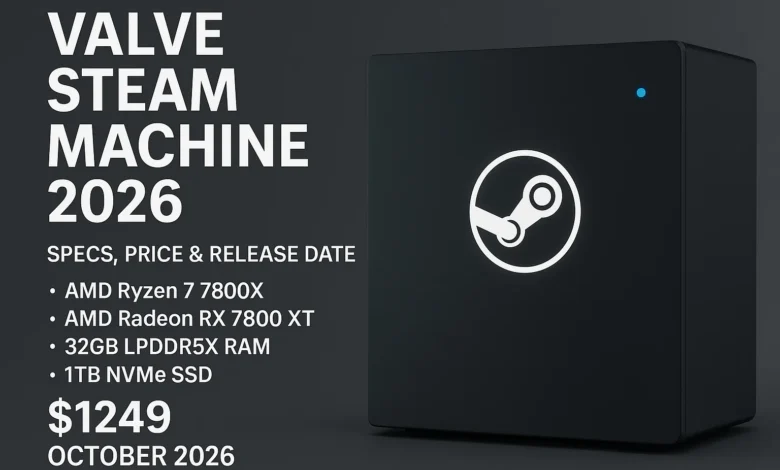
After a decade in hibernation, the Valve Steam Machine is making a triumphant comeback in early 2026. This isn’t just a refresh of the failed 2014 experiment—it’s Valve’s ambitious vision for the future of living room gaming, powered by the lessons learned from the wildly successful Steam Deck.
The new Steam Machine represents something gaming has desperately needed: a bridge between PC gaming’s vast library and console gaming’s simplicity. With custom AMD hardware, the revolutionary SteamOS, and a competitive price point, this compact gaming PC could reshape how millions play their favorite titles.
Let’s dive deep into everything you need to know about the Valve Steam Machine, from detailed specifications to pricing predictions and how it stacks up against PlayStation 5 and Xbox Series X.
What Is the Valve Steam Machine?
The Steam Machine is Valve’s compact gaming PC designed specifically for living room entertainment. Think of it as a console-like experience with the power and flexibility of a gaming PC—all running on Valve’s Linux-based SteamOS operating system.
Unlike traditional gaming consoles, the Steam Machine gives you access to your entire Steam library (over 60,000 games), the ability to install other game stores, and the freedom to customize your system. It’s designed to sit comfortably next to your TV, delivering 4K gaming at 60 FPS through AMD’s FSR upscaling technology.
The device measures a compact 156mm x 152mm x 162mm, making it roughly the size of two Nintendo GameCubes stacked together. Its sleek black design with customizable LED lighting and swappable front plates ensures it’ll blend seamlessly into any entertainment setup.
Steam Machine Release Date: When Can You Buy It?
The Steam Machine will launch in Q1 2026, according to Valve’s official announcement. This means you can expect availability no later than March 31, 2026, barring any unforeseen delays.
Valve announced the Steam Machine alongside two other major hardware releases:
- Steam Frame VR headset (also Q1 2026)
- Steam Controller 2 (bundled with Steam Machine)
The early 2026 release window positions the Steam Machine perfectly to capture gaming attention before any potential next-generation console announcements from Sony or Microsoft later in the year.
Valve Steam Machine Specifications: Power Under the Hood
CPU Performance
The Steam Machine features a semi-custom AMD Zen 4 processor with impressive specifications:
- 6 cores and 12 threads
- Maximum boost clock: 4.8 GHz
- TDP: approximately 30W
- Architecture similar to Ryzen 5 7600
This CPU configuration provides plenty of horsepower for modern gaming at 60 FPS, with enough headroom for multitasking and background processes that enhance the gaming experience.
GPU Capabilities
At the heart of gaming performance is a semi-custom AMD RDNA 3 GPU:
- 28 Compute Units (CUs)
- Clock speed: 2.45 GHz
- 8GB GDDR6 VRAM
- TDP: 110-130W
- Performance comparable to AMD Radeon RX 7600
The GPU delivers approximately 10.5-11.5 TFLOPS of computing power, positioning it between Xbox Series S and PlayStation 5 in raw performance. While the 8GB VRAM has raised some concerns among enthusiasts, Valve maintains this configuration supports all current Steam titles with appropriate settings.
Memory and Storage Options
The Steam Machine includes 16GB DDR5 system RAM via user-replaceable SO-DIMM modules, ensuring smooth multitasking and future upgrade paths.
Storage options include:
- 512GB NVMe SSD (base model)
- 2TB NVMe SSD (premium model)
- MicroSD card expansion (hot-swappable with Steam Deck)
- Support for M.2 2230 and 2280 SSD upgrades
Connectivity and Ports
Comprehensive connectivity ensures compatibility with all your gaming peripherals:
- DisplayPort 1.4 (4K at 240Hz support)
- HDMI 2.0 with HDR and FreeSync
- Gigabit Ethernet port
- USB-C 10 Gbps
- Four USB-A ports
- Wi-Fi 6E
- Bluetooth 5.3
- Built-in 2.4 GHz radio for Steam Controller
How Powerful Is the Steam Machine? Performance Analysis
Gaming Performance Expectations
According to Valve, the Steam Machine delivers over 6x the performance of the Steam Deck. In practical terms, this translates to:
- 4K gaming at 60 FPS with AMD FSR upscaling
- 1080p native gaming at high settings in most titles
- Medium settings with ray tracing in demanding games
- Smooth performance in esports titles at high refresh rates
During internal testing, Cyberpunk 2077 averaged 65 FPS at 4K using FSR upscaling from 1080p on medium settings with basic ray tracing enabled. This impressive benchmark demonstrates the system’s capability to handle even the most demanding modern titles.
Comparison with Current Consoles
How does the Valve Steam Machine stack up against established consoles?
vs. PlayStation 5:
- Similar TFLOPS performance (10.5-11.5 vs 10.28)
- Newer Zen 4 CPU architecture (vs PS5’s Zen 2)
- Less VRAM available (8GB vs PS5’s 16GB unified)
- More upgrade flexibility
vs. Xbox Series X:
- Lower GPU performance (10.5-11.5 TFLOPS vs 12 TFLOPS)
- More modern CPU architecture
- Smaller form factor
- Open platform advantages
vs. Xbox Series S:
- Significantly more powerful GPU
- Better CPU performance
- More storage options
- Superior memory configuration
According to Valve engineer Yazan Aldehayyat, the Steam Machine outperforms 70% of current gaming PCs based on Steam Hardware Survey data, making it a compelling option for the mainstream gaming market.
Steam Machine Price: What Will It Cost?
While Valve hasn’t announced official pricing, industry analysts and experts have provided informed estimates:
Expected Price Range
- 512GB model: $450-$500
- 2TB model: $600-$700
Analysts suggest the $400-$500 sweet spot would maximize market impact and directly challenge current console pricing. This range aligns with Valve’s strategy of prioritizing market share over short-term profits.
Value Proposition
When comparing the Steam Machine price to building a similar gaming PC:
- Equivalent custom PC build: $800-$1,000
- No operating system cost (SteamOS is free)
- Bundled Steam Controller (estimated $99 value)
- Optimized form factor and cooling solution
The pricing must compete with:
- PlayStation 5: $499 (disc) / $449 (digital)
- Xbox Series X: $499
- Xbox Series S: $299
- Gaming PCs with similar specs: $700-$900
Given Valve’s proven willingness to sell hardware close to cost (as demonstrated with Steam Deck), competitive pricing seems likely. They’ve explicitly stated they’ll price it as a “regular gaming PC” with similar specifications.
SteamOS: The Secret Weapon
What Makes SteamOS Special?
The Valve Steam Machine runs SteamOS 3.7, a heavily modified Linux distribution that transforms the PC gaming experience into something beautifully simple:
- Console-like interface: Big Picture mode by default
- Instant suspend/resume: Pick up games exactly where you left off
- Wake-on-controller: Power on the system from your couch
- Proton compatibility layer: Play Windows games seamlessly on Linux
- Desktop mode: Full Linux desktop for advanced users
Gaming Compatibility
Thanks to Valve’s Proton technology, the vast majority of Steam’s 60,000+ game library works flawlessly on SteamOS:
- Verified games run perfectly out of the box
- Playable games work with minor tweaks
- Unsupported games can often run in Desktop mode
- Native Linux games perform optimally
You’re not locked into Steam either. Install Epic Games Store, GOG Galaxy, EA App, or any other PC game launcher through Desktop mode.
Software Ecosystem
Beyond gaming, SteamOS supports:
- Emulation software for retro gaming
- Streaming applications (Netflix, YouTube, etc.)
- Web browsers
- Productivity software
- Alternative operating systems (you can install Windows if desired)
Design and Build Quality
Compact Form Factor
The Steam Machine measures just 3.75 liters in volume—dramatically smaller than the 55+ liter volume of typical mid-tower gaming PCs. This compact cube design maximizes desk and entertainment center space.
Cooling Innovation
Despite the small footprint, Valve engineered an impressive cooling solution:
- Single 120mm fan design
- Server rack-inspired airflow architecture
- Comprehensive heatsink covering CPU, GPU, memory, and power delivery
- Quiet operation even under load
Engineers report the system remains remarkably quiet during intensive gaming sessions, a crucial consideration for living room gaming.
Customization Options
Personalize your Steam Machine with:
- Swappable front plates: Custom designs and colors
- Customizable LED strip: System status indicators in your preferred colors
- Compact aesthetic: Blends with any entertainment setup
Steam Controller 2: Perfect Pairing
The Steam Machine ships bundled with Valve’s redesigned Steam Controller, featuring:
- Dual trackpads (inherited from Steam Deck)
- Traditional analog sticks
- Extra shoulder buttons
- Gyroscopic controls
- Haptic feedback
- 35+ hour battery life
- 2.4 GHz wireless connection (no latency)
This controller represents Valve’s decade of refinement in PC gamepad design, combining the precision of mouse-like controls with traditional console ergonomics.
Who Should Buy the Valve Steam Machine?
Perfect For:
- Steam Deck owners wanting big-screen gaming
- Console gamers curious about PC gaming’s vast library
- Budget-conscious PC gamers needing capable hardware
- Living room gamers prioritizing compact, quiet systems
- Linux enthusiasts supporting open platforms
- Retro gamers leveraging emulation capabilities
Maybe Not For:
- 4K 120Hz enthusiasts (limited to 60Hz)
- Competitive high-refresh-rate gamers (better served by dedicated gaming PCs)
- Users needing maximum graphical settings (8GB VRAM limitations)
- Those wanting physical game media
Potential Concerns and Limitations
VRAM Constraints
The 8GB GDDR6 VRAM represents the most controversial specification choice. Modern AAA games increasingly demand more video memory, potentially requiring:
- Reduced texture quality settings
- Lower resolution rendering with upscaling
- Careful settings management in VRAM-heavy titles
However, Valve’s optimization expertise and SteamOS’s efficiency may mitigate these concerns for most users.
Display Limitations
- HDMI 2.0 instead of HDMI 2.1 limits 4K output to 60Hz
- No native 4K 120fps support for compatible displays
- DisplayPort 1.4 offers higher refresh rates but requires compatible monitors
No Upgrade Path for GPU
Unlike traditional gaming PCs, the GPU is soldered to the motherboard, eliminating future graphics upgrades. RAM and storage remain user-upgradeable.
How to Prepare for Steam Machine Launch
Building Your Game Library
Start preparing now:
- Create a Steam account (if you don’t have one)
- Wishlist games and watch for sales
- Check Proton compatibility for your favorite titles at ProtonDB
- Consider Game Pass PC for additional gaming value
System Requirements
Ensure your setup is ready:
- 4K HDR-capable TV or monitor
- Ethernet connection (recommended for online gaming)
- Adequate ventilation space
- Compatible controllers or peripherals
Steam Machine vs Steam Deck: Which Should You Choose?
Choose Steam Machine if:
- You primarily game on TV or monitor
- You want better performance for demanding titles
- You need more storage capacity
- You prefer desktop gaming sessions
Choose Steam Deck if:
- Portability is essential
- You game during commutes or travel
- Budget is tighter ($399+ vs estimated $450+)
- You want the proven, refined handheld experience
Best of Both Worlds
The beauty of SteamOS: buy both and seamlessly swap your microSD cards between devices. Your game saves sync automatically through Steam Cloud, creating a unified gaming ecosystem.
Conclusion
The Valve Steam Machine represents Valve’s most mature attempt yet at bringing PC gaming to the living room. With a decade of lessons learned from the Steam Deck’s success, competitive hardware specifications, and the polished SteamOS experience, it addresses nearly every criticism of the original Steam Machines.
At an estimated $450-$600 price point, the Steam Machine offers exceptional value for gamers seeking console convenience with PC flexibility. The ability to access your entire Steam library, install other game stores, run emulators, and customize your system makes it compelling for both console converts and existing PC gamers.
The main question isn’t whether the Steam Machine is worth buying—it’s whether you can wait until Q1 2026 to get your hands on one. With Valve’s track record of hardware availability challenges, securing a pre-order might be crucial.
For gamers tired of walled gardens, expensive game prices, and closed ecosystems, the Valve Steam Machine isn’t just another console—it’s gaming’s next revolution.
FAQs
Q Can I install Windows on the Steam Machine?
Yes! The Steam Machine is a full PC, allowing you to install Windows 11 or any other operating system. However, you’ll lose SteamOS’s console-like optimizations and need to manage drivers yourself.
Q Will Xbox Game Pass work on Steam Machine?
Game Pass PC games can run through Desktop mode with some configuration. However, it’s not as seamless as on Windows. Expect varying compatibility.
Q Can I upgrade the Steam Machine components?
You can upgrade the RAM (SO-DIMM modules) and storage (M.2 SSD). The CPU and GPU are soldered and cannot be upgraded.
Q Does Steam Machine support VR gaming?
Yes! It works seamlessly with the new Steam Frame VR headset and should support other PC VR headsets through SteamVR.
Q How loud is the Steam Machine during gaming?
According to Valve engineers and early previews, the single-fan cooling system remains remarkably quiet even under heavy gaming loads, making it ideal for living room use.
Read More: Exploring the Role of Technology in Enhancing Senior Care Home Services